Every company selling an NAD+ supplement opens with the same sentence, and the sentence is true. Nicotinamide adenine dinucleotide sits in every cell you own. It carries electrons through the reactions that turn food into usable energy, and it is the co-substrate that a family of repair proteins called sirtuins cannot work without. Levels fall as you get older. By middle age the drop is around 50 percent.
That much is free. Any brand can say it, and most of them do, because nobody is ever asked to prove it. The expensive sentence is the second one: the claim that a capsule puts some of it back.
Almost nothing separates NAD+ products at the level of the first sentence. Everything separates them at the level of the second. What follows is a four question audit you can run on any bottle in the category, in the order that matters, together with what happens when you run it on Basis, the product Elysium Health has been selling since 2015.
The premise, in three numbers
- 50%approximate decline in NAD+ by middle age
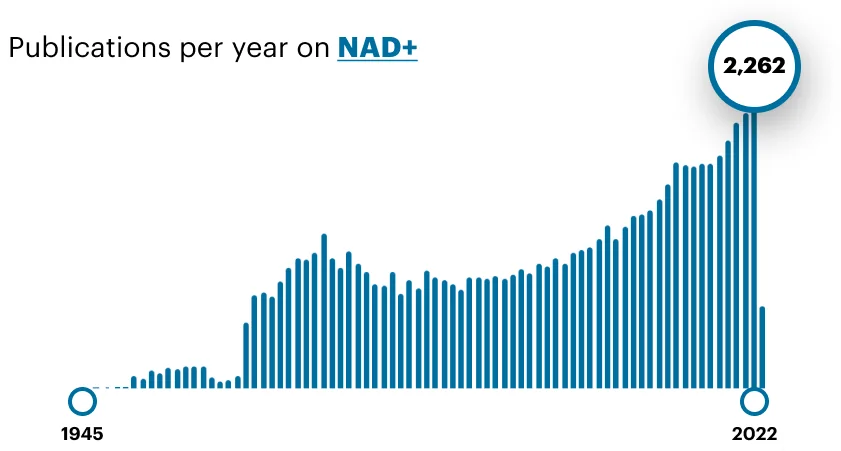
- 2262papers published on NAD+ in 2022 alone
- 1945the year the first one appeared
Decline figure and publication counts as published by Elysium Health on its product and science pages.
What the molecule actually does, in two jobs
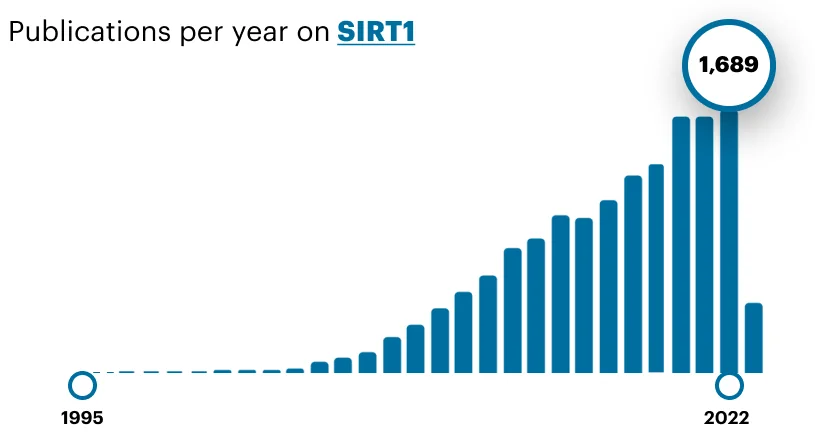
NAD+ runs two separate lines of work, and Elysium splits them the same way in its own explainer. The first is metabolic. NAD+ accepts and donates electrons in the chain that converts nutrients into cellular energy. Nothing about that job is negotiable. The second is regulatory. NAD+ is required by sirtuins, the proteins that supervise cellular housekeeping. Sirtuins can only function in the presence of NAD+, as the company puts it. When NAD+ falls, sirtuin activity falls with it.
That is why the molecule became a target rather than a curiosity. You cannot simply swallow NAD+ and expect it to arrive intact. What you can swallow is a precursor, a smaller molecule your cells convert. Basis uses nicotinamide riboside, a naturally occurring form of vitamin B3, which the body turns into NAD+ in a two step process. It pairs that with pterostilbene, a polyphenol found in blueberries and a more potent relative of resveratrol, aimed at the sirtuin side of the ledger.
The route, as Elysium describes it
Basis is a two ingredient formula. NR is the raw material the cell converts into NAD+. Pterostilbene is aimed at the sirtuin side, which is the reason the two are in the same capsule rather than sold separately.
Question oneWas it ever tested in a person?
Most of what gets written about NAD+ comes from cells in a dish and from mice. That work is real, and it is also the cheapest kind of evidence to point at, because a molecule that lights up a petri dish has cleared none of the obstacles between a lab bench and your bloodstream. The first question is therefore blunt. Did anyone give this to human beings and measure what happened.
Elysium did, and it was the first trial of its kind for nicotinamide riboside: the first repeat dose study, and the first test of NR combined with pterostilbene in people.
The trial, as registered and reported
- Participants120 healthy adults
- Ages60 to 80
- SitesLondon (Ontario), Orlando, Irvine
- ArmsPlacebo, 1x dose, 2x dose
- MeasuredNAD+ in whole blood, day 30 and day 60
- RegistryNCT02678611
Details published at elysiumhealth.com/pages/science-behind-basis and elysiumhealth.com/pages/science.
Question twoWas there a placebo group, and was anybody blinded?
An uncontrolled study of a supplement will almost always produce a happy number, because the people who enroll want it to work and the people running it want it to work too. Randomization and blinding exist to take that wanting out of the result. Elysium's trial was double blind, randomized and placebo controlled, with three arms rather than two.
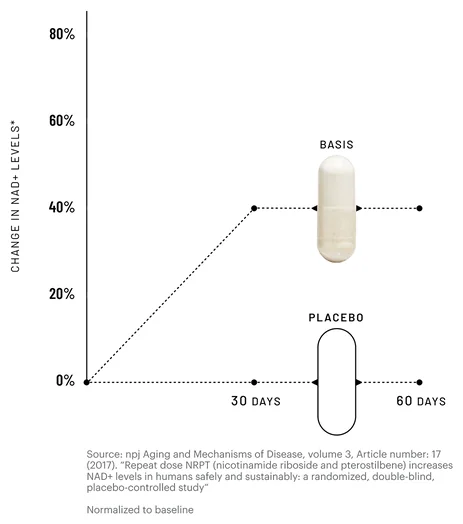
The reported outcome: participants on the recommended dose saw cellular NAD+ rise by an average of 40 percent over baseline at 30 days, and that level held at 60 days. Participants on double the recommended dose rose 90 percent at 30 days, then settled back to 55 percent at 60. The placebo group had no increase at all. No serious adverse events were reported.
Average change in NAD+ versus baseline, by arm
Chart drawn from the figures Elysium publishes for its first human trial. The second row is the one worth pausing on. Doubling the dose did not double the steady state, which is the sort of detail a marketing chart usually leaves out.
Question threeCan you read the paper yourself?
A trial that exists only as a sentence on a product page is a claim, not evidence. The version that counts is the one a reviewer outside the company saw, with the methods attached, in a journal you can open. Elysium's first study was published in November 2017 in a peer reviewed Nature partner journal, open access, and the company states plainly that publishing in open access peer reviewed journals is a policy rather than an accident.
The paper
Dellinger RW, Santos SR, Morris M, Evans M, Alminana D, Guarente L, Marcotulli E. Repeat dose NRPT (nicotinamide riboside and pterostilbene) increases NAD+ levels in humans safely and sustainably: a randomized, double blind, placebo controlled study. npj Aging and Mechanisms of Disease, 2017 Nov 24; 3:17. doi: 10.1038/s41514-017-0016-9.
You do not have to be a biochemist to get value out of a citation like that. The author list tells you the chief scientist and the chief executive both put their names on the result, which means neither can quietly disown it later. The journal name tells you a third party reviewed the methods. The date tells you the claim has been standing in public, available to be attacked, for the better part of a decade.
Question fourIs the dose in the bottle the dose in the study?
This is where most claims in the category quietly come apart, and it is the easiest of the four to check. A brand cites a trial. The trial used a specific quantity of a specific compound. The product contains something less, or something adjacent, or a proprietary blend that refuses to say. The citation stays on the page. The dose does not match it.
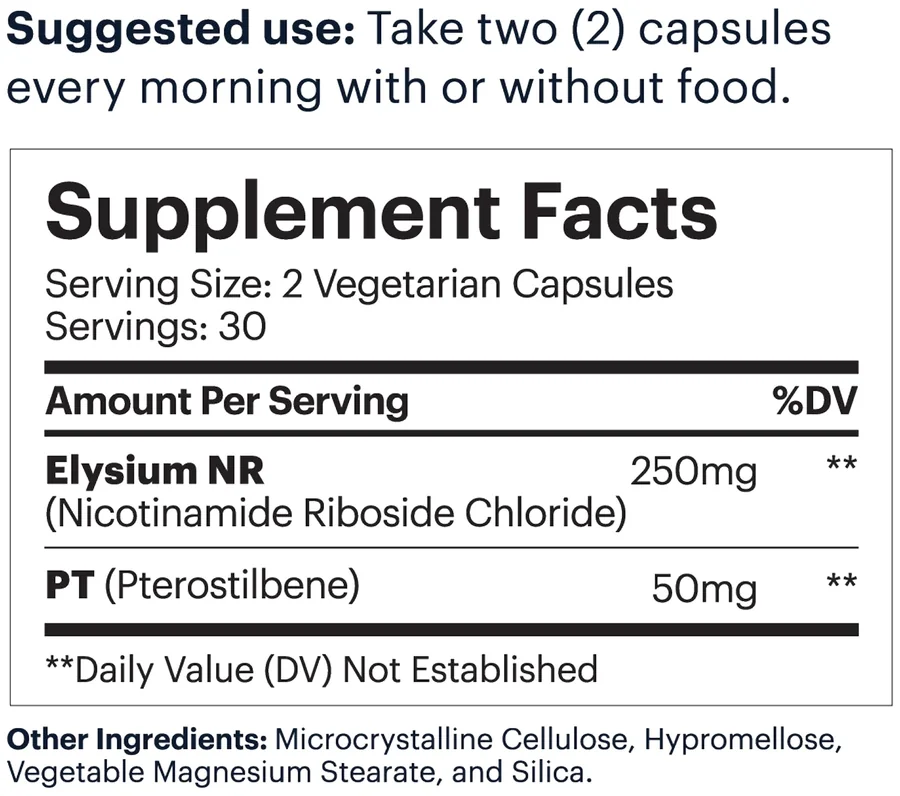
The recommended arm of the Basis trial took 250 mg of nicotinamide riboside and 50 mg of pterostilbene. The supplement facts panel on the pouch reads Elysium NR 250 mg and PT 50 mg per serving, a serving being the two capsules you take in the morning. Two numbers, one panel, thirty seconds of your time.
What happened when one of the answers came back no
A company that only ever publishes the studies that worked has told you nothing at all, because you have no way to know how many did not. So the most informative item on Elysium's science page is not one of its wins.
On the record, on their own site
A study run with researchers at Aarhus University in Denmark tested the NR and pterostilbene combination on muscle repair in older adults. The company's own summary: the combination was well tolerated but did not improve recruitment of muscle stem cells after muscle injury. Soreness tended to be lower in the treatment group. The result is published, and it sits on their science page in the same list as the positive ones.
That is a negative result about their own molecule, kept in public view, next to a buy button. It is the single strongest thing on the page, and it is strongest precisely because it is unflattering.
Seventeen registrations, and who is holding the clipboard
The other reason to look past the marketing copy is the registry. A trial listed on ClinicalTrials.gov has to declare, before it starts, what it will measure and when. That declaration is what makes it hard to run a study, dislike the answer and change the question afterwards. Elysium's science page carries seventeen of those identifiers.
A sample of the registered work
NCT02678611The first repeat dose human trial of BasisNCT03818802Mayo Clinic, bone and skeletal muscle in agingNCT03176628Massachusetts General Hospital, phase INCT05593939University of Copenhagen, markers of agingNCT05483465University of Oklahoma, brain vascular health and memoryNCT03754842Aarhus University, muscle injury and repairNCT06018467Odense University Hospital, bone markers
Seven of the seventeen identifiers listed at elysiumhealth.com/pages/science. Most of these are investigations of the compound run by hospitals and universities, not claims about the pouch on your shelf. Several are still open, and their answers are not Elysium's to write.
Two of the completed studies were reported in journals with no stake in the outcome, one in Hepatology and one in Nature Aging. A separate toxicology study of the company's proprietary form of nicotinamide riboside appeared in the International Journal of Toxicology in 2020. Whatever you make of the conclusions, the pattern is a company that keeps handing its molecule to people who are free to say no.
Who signs off, and what that signature covers
Basis was developed by Leonard Guarente, co-founder and chief scientist at Elysium, professor of biology at MIT and head of its aging center. He is one of the people who established that sirtuins matter to aging in the first place, which is the field this whole product category grew out of.

"I believe Basis is a product that can improve cellular health and target, at least, some of the deficits incurred by aging. It is an important part of a strategy that I follow, along with exercise and a healthy diet, to maintain an active life as I enter my seventies, and hopefully much longer."
Leonard Guarente, Ph.D., Elysium co-founder and chief scientist, quoted on elysiumhealth.com
Behind him sits a scientific advisory board of more than 25 researchers and clinicians, eight of them Nobel laureates. The useful detail is in the small print of how it works. Elysium states that the board does not endorse a specific product. It advises on which compounds to pursue, how to design the studies and what the research says. That is a narrower claim than most brands would make with the same names, and it is the honest one.
- Carolyn BertozziStanford University
- Aaron CiechanoverTechnion, Israel
- Eric KandelColumbia University
- Martin KarplusHarvard University
- Paul ModrichDuke University
- Sir Richard RobertsNew England Biolabs
- Thomas SüdhofStanford University
- Jack SzostakUniversity of Chicago
The eight Nobel laureates named on elysiumhealth.com/pages/advisory-board, alongside more than seventeen other scientists and clinicians.
"The company boasts an impressive board of scientific advisors and presents results of its clinical trials." Business Insider, quoted on Elysium's news and media page
The part that has nothing to do with the paper
A trial validates a formula. It says nothing about the specific pouch a courier leaves at your door, and in a category with a long history of contamination and label inflation, that gap is not academic.
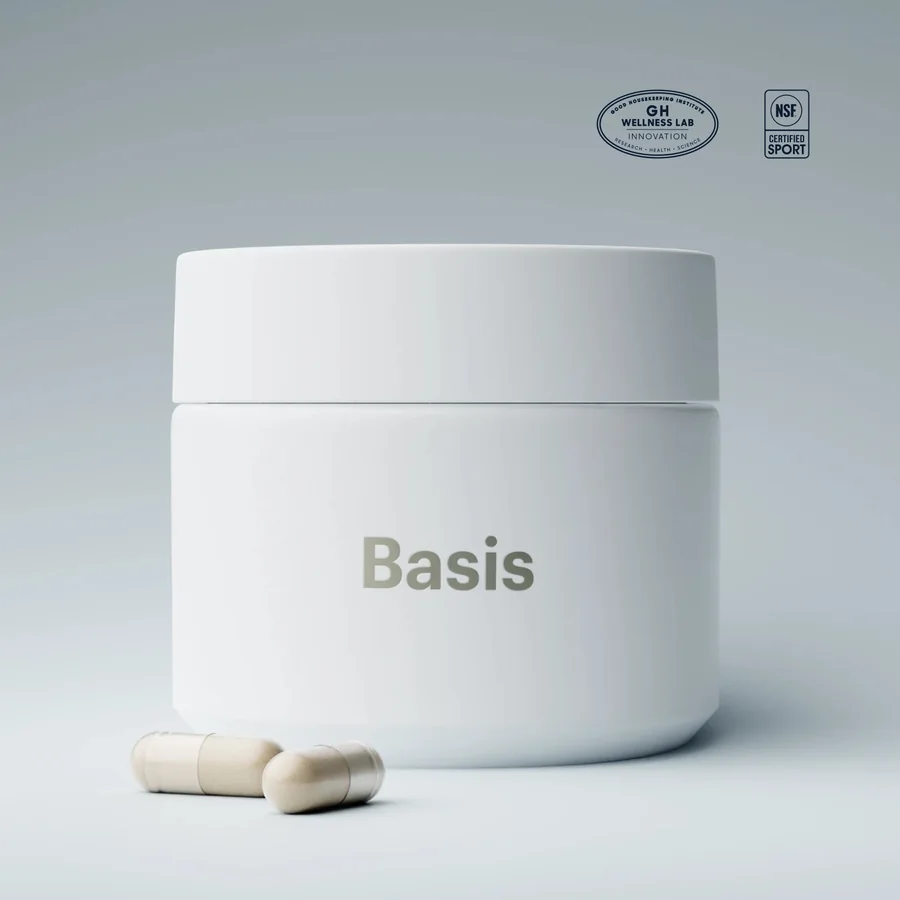
Basis is NSF Certified for Sport, which is the only independent third party certification program recognized by the United States Anti-Doping Agency. Certification is granted lot by lot, not once and forever, and Elysium publishes the certification status and the quality and purity information for every lot it ships. That means the number on the bottom of your pouch is checkable against a public record, by you, on a Tuesday, without asking anyone's permission.
Four checks, one product page
Human trial, placebo controlled, published open access, dose matched to the panel. The study, the supplement facts and the lot records are all linked from the same place.
See Basis at Elysium Health $65 per pouch, a 30 day supply. Ships in the United States and Canada.The honest ceiling on a 40 percent
Here is what the trial did not do. It measured NAD+ in whole blood. It did not measure how you feel on a Thursday, and no reading of it should promise that. Elysium says as much in its own FAQ: Basis is designed to work beneath the surface, and you may not feel different despite what the company believes is happening inside.
You can watch that play out in their own review section, which they have not scrubbed.
★★★☆☆
No discernible benefits
"I have been taking Basis for about four years. I cannot identify any noticeable benefit from taking it."
Morton, verified buyer, published on elysiumhealth.com
Leaving that on a product page is a choice. The alternative reading of the same evidence is the one you get from people who decided the mechanism was reason enough and stayed on it for a decade.
What long term customers actually say
Basis carries 1,293 published reviews at an average of 4.5 out of 5. What is unusual about the set is its tenure. A large share of the writers are not reporting on a first month. They are reporting on year seven, year ten, year twelve.
★★★★★
I've been taking Basis since 2016.
"I have been taking Basis since 2016 and will continue to take it. I feel that it has made such a difference in my preventative health care. I'm in my early 70s now and recommend it to everybody."
Cheryl M., verified buyer, age 70+
★★★★★
BASIS makes sense
"The science behind NAD+ supplementation and BASIS is sound. And I feel better and do more as I am about to turn 69 than I ever imagined I would when I started taking BASIS 10 years ago. I view BASIS as a very sound and satisfying investment in my health."
Steven R., verified buyer, age 60-69
★★★★★
Mrs
"Have taken Basis for 7+ years starting at age 70. I feel it has helped with energy, mental alertness and overall well being. I still walk 5 miles a day and play tennis 3-4 times a week."
Pat M., verified buyer, age 70+
★★★★★
Wishful
"I have been taking basis for several years now. I can't remember how many. Nonetheless, I think it has contributed to my well-being at the age of 86. It is difficult to be certain because I don't have another me who is not taking it. I trust the founders of Elysium Health because of their scientific expertise and, I hope, personal integrity."
Sarah M., verified buyer, age 70+
Sarah's second sentence is the whole problem of the category, stated better than most trial write-ups manage. Nobody has a control version of themselves. Which is exactly why the four questions above are worth the ten minutes: they are the only part of the decision that does not depend on how you happen to feel this week.
The practical part
Basis, at a glance
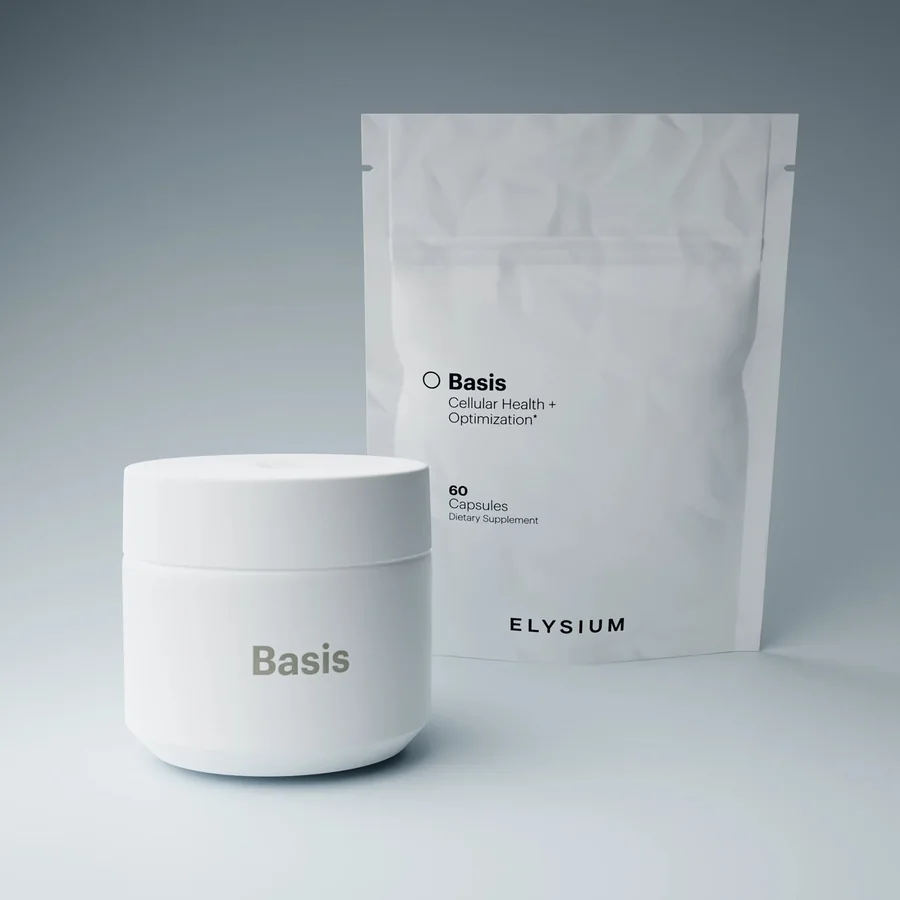
- Price$65 per pouch
- Supply30 days, 60 capsules
- Serving2 capsules each morning
- Per servingNR 250 mg, PT 50 mg
- Third partyNSF Certified for Sport
- DietVegetarian, vegan, gluten free, nut free
- Ships toUnited States and Canada
Taken with or without food. Intended for healthy adults only. Not for use if you are pregnant or nursing. Speak with your physician before starting any supplement.
Run the four questions on anything else
The audit is not about one brand. It is a filter, and it works on any bottle in any aisle that leans on a mechanism to justify a price.
The filter, in general form
- 1. HumansA trial in people, not cells
- 2. ControlsRandomized, blinded, placebo arm
- 3. PublishedA journal you can open
- 4. DosePanel matches the study
Most bottles fail at question one. A good number of the survivors fail at question four, which is the one that takes thirty seconds and almost nobody runs.
Basis clears all four, and shows its work
The trial, the paper, the supplement facts panel and the lot by lot certification records are published in one place, along with the study that came back negative.
See Basis at Elysium Health $65 per pouch. Developed by Leonard Guarente, Ph.D.